What Does It Mean to Dream About a Black Widow Spider?
You see the red mark first. A small black shape in a corner, on a web, on the bed — and your whole body knows what it is before your mind catches up. Few dream visitors arrive with a warning written on them. But stay with the dream a moment before you fear it. The black widow is a symbol, not a sentence. In dream language she usually stands for one specific thing in your life: something quiet and patient that you already suspect is not good for you — and that your sleeping mind has decided to show you clearly, red mark and all.
For spiders in dreams more broadly, see dreaming of spiders — you may also want to read about dreaming of scorpions and dreaming of snakes.
Know someone who keeps dreaming this? Send it to them 👇
The Core Meaning
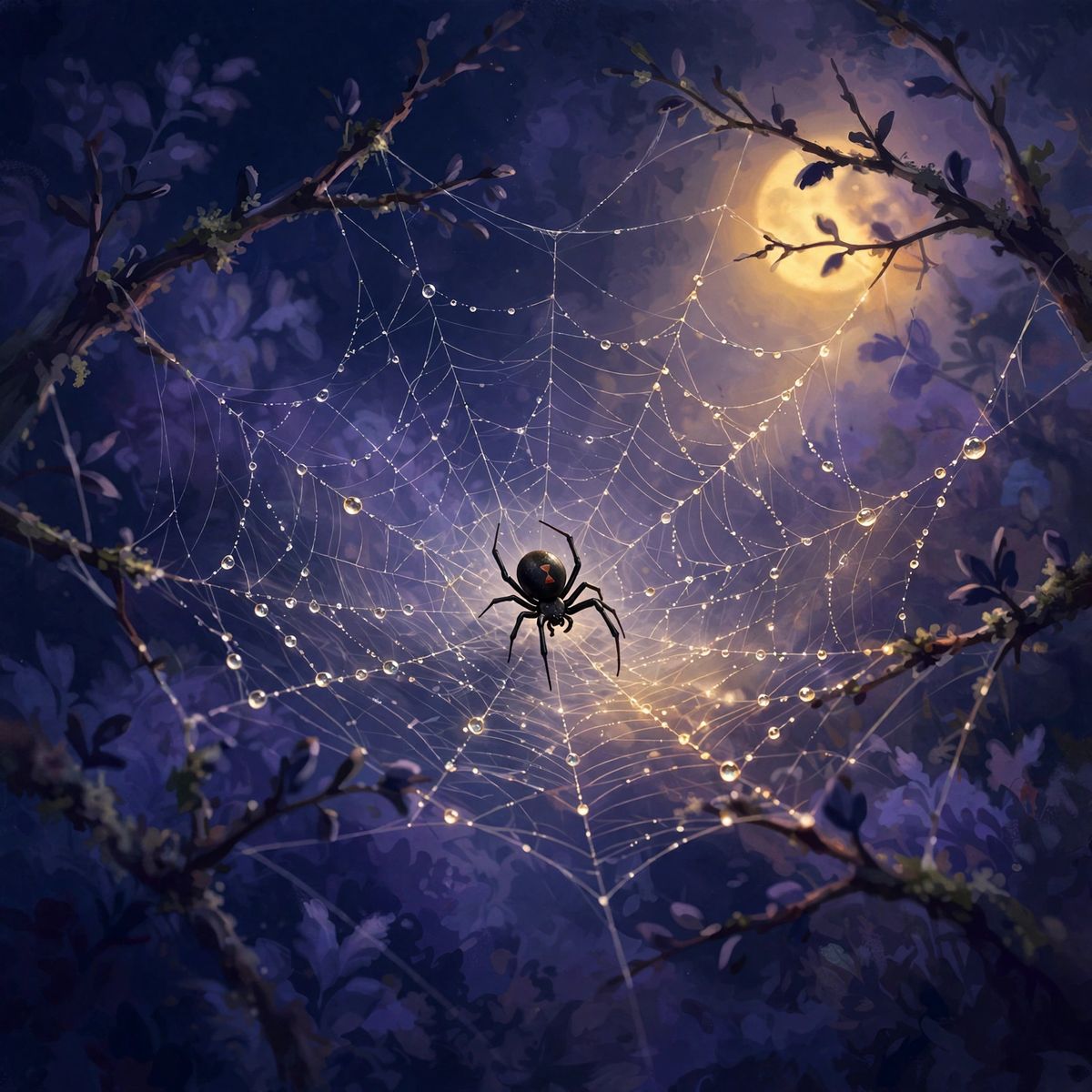
A dream spider can mean many things, but a black widow is not any spider, and the dream knows it. She is small. She is hidden — a corner, a shoe, the underside of things. She is patient beyond measure, willing to wait in the dark for as long as it takes. And she carries her warning on her body: that small red hourglass, bright as a sign. Put those four things together and you get the heart of this dream. It tends to point at a harm that is quiet rather than loud — something in your life that waits, hides, and costs you a little at a time.
Most often, readers tie this dream to a draining bond. Not a dramatic enemy — the widow is never dramatic. She is the person whose company leaves you strangely tired, the friendship that runs on small stings, the arrangement where you give and give and somehow end up apologising. Her venom in dream language is rarely about one big attack. It is about doses: the remark that lingers for days, the promise that keeps quietly breaking, the love that asks you to shrink. If a face came to mind while you read this, the dream has probably already done its main work.
The web matters as much as the spider. A web is a thing you do not notice until you are in it, and black widow dreams often arrive when a situation has that same feel: a job, a debt, a duty, a tie — each thread small on its own, together hard to leave. Notice, though, where you stood in the dream. Outside the web, watching her, you are the one who sees clearly. Caught in the threads, you feel the trap. The same spider, two very different reports about where you stand.
And there is a second, kinder face to this symbol, and it would be wrong to skip it. The widow is also a maker. She builds. She waits with a patience most of us never learn, and she survives in hard places. Some readers meet her in dreams during seasons when a person is quietly building something of their own — a craft, a business, a new life — in a corner, out of sight, asking nothing of anyone. Which face of her you dreamed depends on the feeling that came with her. Fear points one way. Calm points the other. Both are worth reading.
A Psychological Perspective
Psychology starts with the fear itself, because it is so old. Humans notice spiders fast — faster than almost any other shape — and researchers think we may be built that way, tuned by a long history in which a small bite could matter. That built-in alarm is why this dream feels so strong on the skin. But an alarm is not an accusation. In the psychology reading, the black widow in your dream is less about the world outside you and more about a feeling inside you: wariness. Your mind reached for the most watchful creature it knows to picture a watchfulness you already carry.
Jung would ask about the shadow — the parts of life, and of ourselves, that we keep in the corner of the room. The widow is a classic shadow shape: dark, female, patient, and feared out of all proportion to her size. In that frame, she can stand for something you have pushed out of sight — a truth about a relationship, a habit of your own, a wish you do not approve of — which waits in the dark with perfect patience until you are ready to look at it. Shadow work, in Jung's sense, is never about fighting the creature. It is about turning toward the corner and asking what is actually there. Most people find it is smaller, and sadder, than the fear suggested.
Everyday psychology adds a practical layer. This dream often follows real triggers: a news story, a spider found in the house, a film scene, a talk about a "toxic" person at work. Stress also sharpens threat dreams — a mind running on poor sleep patrols its borders harder, and stocks the night with guards and warnings. So the first question is always a plain one: did life hand your brain this picture this week? If yes, part of the dream is simple housekeeping. It earns the deeper reading when there was no trigger — or when she keeps coming back, dream after dream, to the same corner of the same room.
Read gently, then, the way the site reads every frightening dream: the widow is information, not injury. She shows you where your own guard is posted. Whatever she is guarding — a bond, a habit, a corner of your own heart — the dream trusts you with the sight of it. That trust is the real message, and it is a compliment to the dreamer, not a threat.
Common Variations & What They May Suggest
- Being bitten by a black widow — the sting form. A bite usually marks the moment something got through your guard: a comment that will not stop echoing, a small betrayal, a kindness withdrawn at the wrong time. Note where it bit you. A hand points to work and to what you make and do; a foot, to your path and plans; the neck or back, to something said or done where you could not see it coming. The dream tends to be about the sting you are carrying, not the one you fear.
- Killing the black widow — the taking-back form, and usually a strong one. It often comes when you are ending, or have quietly decided to end, a draining tie or habit: the resignation drafted, the boundary finally set, the phone call made. Killing her calmly suggests the decision is made and settled deep down. Killing her in a panic, with webs everywhere and more spiders coming, suggests you want out but have not yet found the one real thread to cut.
- A black widow in your bed — the bed is rest, trust, and the place you are most unguarded, so a widow there points the dream at your closest circle: a worry inside a partnership, a secret kept at home, or rest that no longer restores you because something small shares it. This version asks the gentlest, most honest questions — and it asks them about closeness, not danger.
- A black widow in your hair — hair dreams are thought dreams: mind, image, the self you show. A spider in the hair often points to a worry that has got into your thinking and will not be combed out — a fear about how you are seen, or one person's words replaying at night. It sits close to the feeling of being watched and judged, and it often fades when the thought is said out loud to someone safe.
- A calm dream — you watch her and feel no fear — do not let the species fool you; this is often the kindest version of the dream. Watching a black widow calmly, even with respect, tends to picture awareness without panic: you can see the difficult thing in your life clearly now, and it no longer runs you. Some readers take a peaceful widow as the maker's face of the symbol — patience, craft, and a web of your own being built in a quiet corner.
- A fearful dream — running, hiding, frozen — the dread itself is the data. A dream where the fear is huge and the spider stays small often mirrors a worry that has grown in the dark of not-looking: the bill unopened, the talk unheld, the symptom unexamined. Dreams shrink such things when we face them; the fear in this version is frequently the largest part of the problem, and it is the part most in your power.
- Seeing the red hourglass mark clearly — sometimes the dream slows down and shows you the mark, bright and exact. Readers take a clear mark as a clear flag: your mind is underlining the one detail that names the thing — the pattern you recognised, the sign you can no longer call a coincidence. If you woke remembering the red more than the spider, the dream was about recognition. You already know what it marks.
- Many black widows — the numbers form. One widow is one thing; a room of them is a season — several small drains at once, or one worry breeding others in your mind at night. This version often visits people who are carrying a lot quietly: many threads, many corners, no single villain. Its advice is plain: do not fight the room. Find the first thread, the nearest one, and start there.
- A black widow that does not attack — she sits, she waits, nothing happens, and you wake almost puzzled. This is the patience form of the dream, and it often points the symbol back at you: something in your own life is in the waiting stage — a plan, a healing, a slow craft — and the dream is asking whether you can let it take its time, the way she does, without poking at it daily.
- A web with no spider — the empty-web form. The trap or the work is there, but the maker is gone. This can picture a situation you still feel caught in after the person has left — the threads outlast the spider. Or, read warmly, it can show a structure you built that now holds on its own. Which one it is depends on whether the web in the dream felt like a trap or like a net that would catch you.
Two details explain most black widow dreams: how you felt, and what she did. Fear with a bite is one story; calm watching is another entirely. Put the feeling and the action together, and this famous symbol usually turns out to be a precise, and surprisingly gentle, piece of self-knowledge.
Cultural & Spiritual Symbolism
The world's oldest spider stories are not horror stories. In the traditions of several Native American peoples, Spider Grandmother is a creator and a teacher — the wise old woman who spun the world into being and still guides people who listen. In West African tales carried across the ocean, Anansi the spider is the clever storyteller who wins by wit what he could never win by strength. For most of human history, in other words, the spider stood for making, patience, and clever survival. The fear is the newer layer.
Greek myth gives us Arachne, the weaver whose skill challenged a goddess, and who was changed into a spider for her pride and her gift alike. Her story is really about craft — about a maker whose work was so fine it made the powerful uneasy. Readers who meet the black widow kindly often borrow from Arachne: the dream spider as the emblem of a person making something fine in a dark corner, thread by thread, while the world is not watching.
The phrase "black widow" itself is young, and it comes from the spider's own hard story — the female who may eat her mate. Modern culture borrowed the name for a kind of person: calm, charming, and quietly dangerous to love. Dream books of the last century picked the phrase up, and it colours this dream to this day. It is worth holding lightly. The dream borrows the picture of a love that costs too much — it does not hand you a verdict about any real person. Only your waking knowledge of them can do that, and it should be allowed to.
Spiritually, many readers frame the spider as the weaver of fate: the one who sits at the centre of the web and feels every thread. In that frame, a black widow dream is an invitation to notice your own threads — the ties that feed you and the ties that only hold you. A web is not evil. It is a home and a living, honestly built. The dream's question is an old and fair one: which of your threads are yours by choice, and which ones would you quietly cut if no one judged you for it?
What To Do After This Dream
First, the plain check, as with any creature dream: if you live where black widows live, and you have been in sheds, woodpiles or garages lately, a quick look with gloves and a torch is fair housekeeping. Most of these dreams are symbolic — but peace of mind is worth ten minutes, and a calm house makes for calmer dreams either way.
Then do the dream's real homework: name the thread. Write down, in one honest list, the ties that leave you a little emptier each time — the person, the habit, the duty, the late-night scroll. The widow dream almost always has such a list underneath it. You do not have to cut anything today. In this symbol's own language, seeing the web clearly is the first freedom, because a web you can see is one you can choose about.
Take one small step of your own choosing: set the boundary in one place, shorten the visit, close the tab, say the true sentence kindly and once. Small steps suit this dream — the spider herself works in single threads. And if she keeps returning, note where she waits and what you do, night by night; our guide on how to keep a dream journal shows how a few lines a night can reveal the pattern your days keep stepping around.
Frequently Asked Questions
What does it mean to dream about a black widow spider?
Most readers tie it to something you already sense is not good for you: a draining bond, a slow harm done in small doses, or a situation you feel quietly caught in, like a web. The black widow is a specific spider — patient, hidden, and marked in red — so the dream usually points at one specific thing, not danger in general. It is a noticing dream, not a doom dream.
Is a black widow dream a bad omen?
In this tradition, no. The dream is read as a symbol, not a forecast. Spiders have stood for patience, craft, and fate in many cultures, and even the feared black widow is more often read as a warning light you switch on yourself — your own awareness naming something you have been stepping around. What you do with the noticing is the part that matters.
What does it mean to be bitten by a black widow in a dream?
A bite marks the moment words or actions got under your skin — often one sharp comment, one betrayal in miniature, or the day you realised a small harm had been adding up. Where the bite lands can hint at the area of life: a hand points to work and doing, a foot to your path and plans. The dream is usually about the sting you are still carrying, not the spider.
What does killing a black widow in a dream mean?
Killing the spider is the taking-back-control version of the dream. It often comes when you are ending — or ready to end — a draining tie, a bad habit, or a situation that had you caught. Doing it calmly suggests the decision is already made deep down. Doing it in panic, with the web still everywhere, suggests you want out but have not yet found the real thread to cut.
Why do I keep dreaming about black widow spiders?
A repeating black widow usually tracks one unnamed thing: a single person, habit, or arrangement your mind keeps flagging as quietly harmful. Recurrence tends to fade once the thing is named and one real step is taken — a boundary set, a talk held, a thread cut. Note where the spider waits each time; the place often names the part of life it lives in.
Related Dreams
Browse the full dream dictionary A–Z
Beyond this dream: repeating numbers carry messages too — explore the angel numbers index, and notice the patterns with a dream journal.
Part of a bigger pattern: this dream belongs to our Scary & Dangerous Dreams collection — explore all the dreams in this family in one place.
Dream meanings on StarsToday explore symbolic and psychological perspectives to help you reflect — they are insights, not facts, and never medical, mental-health, or professional advice. If a dream leaves you feeling distressed, consider speaking with a qualified professional.