What Does It Mean to Dream About Peacocks?
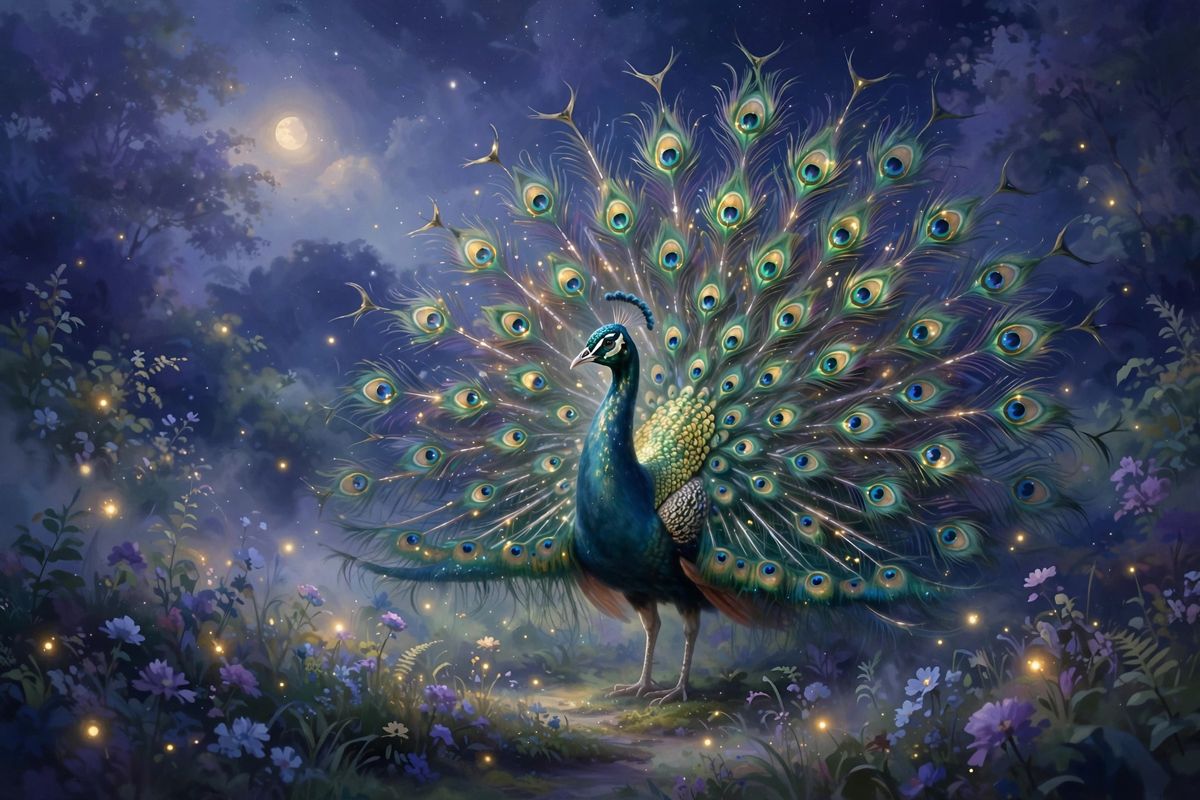
Dreaming about peacocks is dreaming about being seen. The peacock does not hide its beauty — it fans it out and waits for you to look. A peacock dream usually points to pride, display, and the complicated hunger for admiration.
If this dream felt vivid, nearby symbols can add meaning: dreaming of birds or dreaming of butterflies.
Know someone who keeps dreaming this? Send it to them 👇
The Core Meaning
The peacock's whole body is an announcement. No other bird performs like this. So when a peacock shows up in a dream, the first question is about showing off — your own, or someone else's. Are you displaying your beauty, your success, your talents, hoping to be noticed? Or are you watching someone else fan their feathers and feeling something complicated about it?
Showing off beauty sounds shallow until you look closer. Wanting to be seen is one of the most human urges there is. The peacock dream asks about pride in its honest form: not vanity as a sin, but pride as a signal. What are you proud of right now? What do you wish people would notice? And underneath that — what are you afraid they would see if the feathers came down?
There is a shadow side the symbol carries honestly. A peacock that is strutting can also be a warning about pride tipping into display-for-its-own-sake: curating a perfect image while feeling empty inside, collecting admiration that never quite lands. The dream does not judge. It just holds up the tail and lets you look.
A Psychological Perspective
Modern psychology reads the peacock as the image of self-presentation — the managed self we show the world. Think of the last time you rehearsed a casual moment: the photo you posted after taking thirty, the story you told at dinner that you polished first. The peacock is that behavior wearing feathers. It shows up when the gap between the inner life and the outer display gets wide enough to notice.
Performance anxiety lives in this symbol too. A dream peacock that will not open its tail, or one whose feathers look dull, often mirrors impostor feelings — the fear that you are not as impressive as your own presentation suggests. People who dream of a closed-tailed peacock before a big meeting, interview, or date are often rehearsing the same worry: what if I cannot perform when it counts?
Jung would have pointed at the shadow here. The part of you that wants applause is not a flaw to delete; it is a need to understand. A peacock dream can be the psyche's way of saying the need for recognition has gone underground and is now leaking out sideways — through comparison, through social media scrolling, through resentment of people who get what you want.
Common Variations & What They May Suggest
- A peacock dancing with its tail fanned: The full display. This is the symbol at maximum volume: wanting to be seen, admired, or chosen. It often arrives during seasons of ambition — a promotion push, a creative launch, a new relationship. Ask who the audience is in the dream. That person is usually the one you are performing for in waking life.
- A white peacock: The rare, quieter version of the symbol. White peacocks are read as beauty without arrogance — grace, spiritual growth, or recognition that feels pure rather than showy. If the colored peacock is about being admired, the white peacock is about being at peace with being seen.
- A peacock with its tail closed: Beauty held back. This often mirrors holding yourself in — shrinking in meetings, downplaying your looks or talent, refusing to take up space. It can also point to someone near you who has stopped shining, and your quiet worry about them.
- A peacock at your door or in your home: Pride has come visiting. An unexpected honor, a compliment that lands, attention you did not seek — the dream stages it as a visitor. If the peacock in the house feels welcome, you are ready to be recognized. If it feels intrusive, the attention may feel like pressure.
- A peacock losing its feathers: The display is falling apart. This often follows a bruise to the ego — public embarrassment, a rejection, a moment you wish you could take back. But feathers grow back, and the dream knows it: this can also read as a shedding of vanity, a simpler season ahead.
- Chasing a peacock you cannot catch: Recognition that keeps moving away. The dream often mirrors chasing approval — from a parent, a partner, an audience — that never quite lands. The harder the chase in the dream, the more the waking chase is costing you.
Cultural & Spiritual Symbolism
- India: The peacock is India's national bird, and its roots run deep. Krishna wears a peacock feather in his crown; the war god Kartikeya rides a peacock as his vehicle. Classical Hindu dream texts (the Swapna Shastra tradition) read a peacock dream as an omen of honor, beauty, or good fortune approaching.
- China: In Chinese symbolism the peacock stands for beauty, dignity, and high rank. Peacock imagery was used on the robes of high officials — the bird marked a person worth looking at, and being looked at well.
- Ancient Greece: The peacock belonged to Hera, queen of the gods. Myth says she set the hundred eyes of the slain giant Argus into the peacock's tail — which is why the Greek peacock became an emblem of watchfulness: beauty that sees everything, and is seen by all.
- Early Christianity: Christian art used the peacock as a symbol of resurrection and immortality, partly because the bird was believed to renew its feathers and partly because its flesh was thought not to decay. To dream of a peacock in this reading is to dream of renewal that survives the ugly seasons.
What To Do After This Dream
Try one honest journaling prompt: "Whose admiration am I chasing right now?" Write for five minutes without editing. The name or audience that keeps surfacing is what the peacock was about. Then ask the harder follow-up: what would I do differently this week if I did not need that person's approval?
If the dream had a vanity edge — endless display, comparison, showing off — take a one-day comparison detox. Mute the accounts you measure yourself against, skip the mirror-checking, and spend the day making something instead of performing something. Peacock dreams often quiet down once the need to be seen gets a healthier outlet, like creating for its own sake.
For a fuller step-by-step method, our guide on how to interpret your dreams walks you through turning symbols like this one into personal insight.
Frequently Asked Questions
Is dreaming of a peacock good or bad?
Usually good. A proud, displaying peacock is read as confidence, recognition, and beauty being acknowledged. A dull, trapped, or dead peacock flips the reading — pride bruised, or a fear of being judged.
What does a white peacock mean in a dream?
White peacocks are read as a rarer, purer version of the symbol — grace without arrogance. The dream often points to beauty, spiritual growth, or recognition that feels clean rather than showy.
What does a dancing peacock mean in a dream?
A peacock fanning its tail in a dance is the symbol at full volume: wanting to be seen, admired, or chosen. Ask yourself who you have been trying to impress lately — the dream usually names the audience.
What does a peacock feather mean in a dream?
A single feather often stands for a piece of beauty or honor you are carrying — a compliment you treasure, a title you hold, or a talent you show off. If the feather is broken or dull, the dream may question whether that pride still fits.
What does a dead peacock in a dream mean?
A dead or featherless peacock commonly symbolizes wounded pride — a moment of embarrassment, rejection, or feeling suddenly invisible. It can also mark the honest end of a phase where you cared too much about appearances.
Related Dreams
Can’t find your symbol? Browse the complete dream dictionary A–Z.
Beyond this dream: repeating numbers carry messages too — explore the angel numbers index, and notice the patterns with a dream journal.
Part of a bigger pattern: this dream belongs to our Bird Dreams collection — explore all 11 dreams in this family in one place.
Dream meanings on StarsToday explore symbolic and psychological perspectives to help you reflect — they are insights, not facts, and never medical, mental-health, or professional advice. If a dream leaves you feeling distressed, consider speaking with a qualified professional.