What Does It Mean to Dream About a Volcano?
The ground rumbles under your feet. Smoke climbs out of a mountain that was quiet yesterday. Everyone in the dream is looking at you to know what it means. Volcano dreams are pressure dreams. They arrive when something strong — anger, desire, grief, a truth — has been building under the surface of your life. For a long time. And the surface is starting to crack.
Volcano dreams belong with other sudden-force dreams. You may also want to read about dreaming of an earthquake, dreaming of fire and dreaming of storms.
Know someone who keeps dreaming this? Send it to them 👇
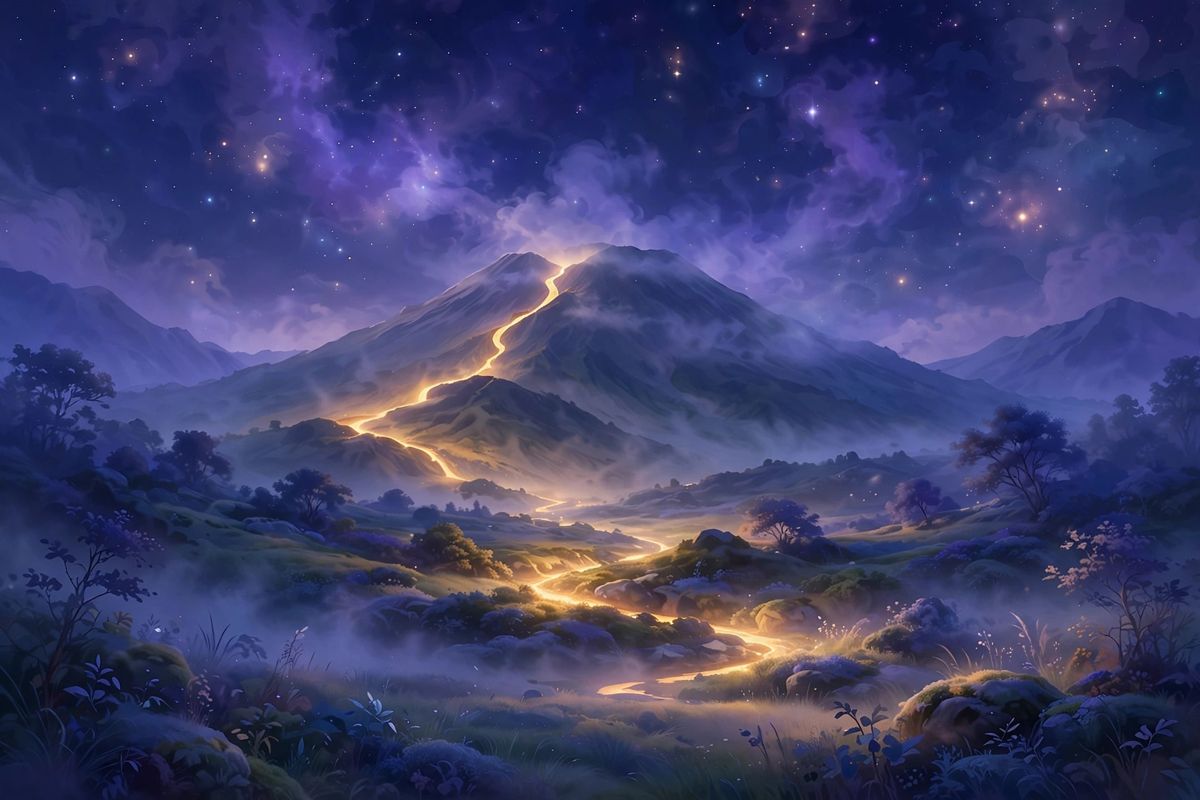
Key insight: A man in his fifties kept dreaming of a quiet volcano with smoke curling from its top. Nothing erupted, but the pressure felt close. In real life he had swallowed his anger for years. At work his manager took credit for his ideas, and at home he said yes to everything to keep the peace. He told himself he was being patient, but his sleep grew short and his temper grew quick. The volcano dream came back again and again. One day, after his manager took credit once more, he spoke up in a calm, firm voice and named his work. He still gets angry sometimes, but now he lets it out in small, honest words. The volcano in his dreams has gone quiet and green.
The Core Meaning
A volcano is stored power. For years it can look like an ordinary mountain — green, calm, good to live beside — while pressure gathers underneath. In a dream, that picture most often stands for a feeling or a situation you have been holding down. It can be the anger you keep swallowing at work. The unhappiness in a bond you never name. The ambition you shelved. The grief that never got its day. The dream is your mind showing you the mountain from the inside.
The state of the volcano is the whole message, so read it first. A sleeping volcano points to something dormant but not dead — an old issue that could wake. A rumbling, smoking volcano points to warning signs you are already seeing in waking life. Small snaps. Short sleep. A temper with a shorter fuse than it used to have. A full eruption points to a release that is either happening now or feels one spark away. And note that an eruption in a dream is not always a disaster. Sometimes it is the truth finally out, the no finally said, the pressure finally off.
There is also a creative reading, and it is kinder than people expect. Volcanoes destroy, but they also build land. Whole islands exist because something erupted. A volcano dream can mark a force in you that wants to make something. A project, a change, a new life on the far side of an honest explosion. What matters is whether the dream felt like doom or like power. Your feeling is the compass here. More than the lava.
Finally, look at your distance. Watching from far away points to a problem you can see coming. Living on the slope points to a situation you have built your daily life around, cracks and all. Standing at the crater's edge points to a decision you are right on top of. The dream places you exactly where you stand in waking life — if you are honest about it.
A Psychological Perspective
Freud's reading of dreams like this is almost too neat. What waking life represses, the dream releases in disguise. Anger is the classic case. A person who "never gets angry" by day may watch mountains explode by night. The feeling has to go somewhere. And the dream is the one place politeness cannot follow. If your volcano dream came after a day of biting your tongue, Freud's explanation may be the whole story. Britannica's guide to volcanoes sets out the plain facts about volcanoes itself, apart from any dream meaning.
Jung read the volcano differently. Not as a blocked feeling, but as energy from the deep self pressing toward change. In his frame, the eruption is the psyche breaking an old shape so a new one can form. The career that no longer fits. The version of you that was built to please. A Jungian reading asks two questions. Not "what am I suppressing?" but "what in me is trying to be born, and why does it have to come up with such force?" The two questions lead to different mornings. And both are worth asking.
Modern research adds the body to the picture. Stress hormones, poor sleep, and even sleeping in an overheated room all raise dream intensity. Threat-simulation theory holds that the brain rehearses danger to keep you ready. A rumbling-volcano dream during a brutal work season may be part symbol, part stress echo. The dream earns deep reading when it repeats. Or when the pressure in it matches your days exactly — because then the symbol and the season are the same thing. The Sleep Foundation's guide to nightmares notes that bad dreams are often tied to stress and strong feelings.
Common Variations & What They May Suggest
- An erupting volcano — the release itself. This often comes when something held back finally breaks through: a row, a confession, a resignation, a breakdown or a breakthrough. Note your feeling as it blows. Terror leans toward a release you fear. Relief leans toward one you have secretly been waiting for.
- A dormant or sleeping volcano — an issue that looks settled but is not. The old disagreement everyone agreed to drop. The habit you quit but still dream about. The dream is not saying it will wake. It is saying part of you knows it could, and plans your peace accordingly.
- Smoke and rumbling, but no eruption — the warning stage, and the most useful dream in this family. Pressure is visible, time remains. It often mirrors the weeks before a blow-up, when small signs are easy to ignore. And cheaper to act on than the eruption will be.
- Running from a lava flow — lava is slow but unstoppable, and that is the point. This variation points to a consequence or a truth moving toward you at walking pace. You can outrun it today, but it does not stop. People often have this dream about debts, deadlines, and talks they keep postponing by exactly one day at a time.
- Lava destroying your house — your house is your base: family, safety, the life you have built. Lava through it points to a held-back force breaking into that base. It can mean a home conflict reaching its peak, a family secret surfacing, or a change that will rearrange daily life. Not just moods.
- Standing on the crater or falling in — the crater's edge is the line between holding it in and letting it out. Standing there points to a decision you are right on top of. Falling in leans toward feeling swallowed by your own intensity. A passion, a rage, or an obsession that has started to run you instead of the other way round.
- Climbing a volcano — the climb is effort toward the source. This version often belongs to people doing hard inner work on purpose. Therapy, recovery, a difficult training, a truth they are walking toward instead of away from. Reaching the top and looking in is a strong sign. You want to see the thing as it is.
- Ash and smoke covering the sky — after the blast, the grey days. Ash dreams lean toward the fallout phase: low mood, unclear thinking, a season where nothing looks bright and every plan feels coated. If the dream's ash slowly settles or rain washes it clean, the read turns hopeful. Fallout ends.
- A volcano erupting in a city — crowds, streets, offices. The public version of the pressure dream: a workplace ready to blow, a public role cracking, or a change moving through your whole community. If you were warning people in the dream, it often mirrors a worry you carry for others at work or at home.
- An underwater volcano — the eruption you cannot see, only feel: bubbles, heat, the sea boiling in one strange patch. This points to a force moving under a calm surface. It can be in a bond that looks fine, or a job that looks stable. Or in you — on days you would describe as "fine" and not quite mean it.
- A volcano with an earthquake — two pressure symbols at once. The ground shakes while the mountain smokes. This pairing usually tracks a season where change is not single but stacked. One foundation moving while another force builds. Read it as a call to steady one thing at a time, not everything at once.
- An extinct volcano — cold, quiet, safe to walk on. This is the past-tense dream: a force that once ruled your life and no longer does. An old anger, an old love, an old fear, visited one more time to show you it has gone still. Many people find this one oddly peaceful. And that peace is the message.
As with all pressure dreams, your role is the sharpest clue. Running points to postponement. Watching from the slope points to a life built around the pressure. Climbing points to courage. Keep your role and your feeling together. The mountain usually explains itself.
Cultural & Spiritual Symbolism
Hawaii gives the volcano its most famous face: Pele, the fire goddess who builds and burns the islands in the same act. In her stories, the volcano is not evil. It is creative power with a temper, owed respect rather than fear. A volcano dream read through Pele asks a sharp question: is the fire in you asking to destroy something, or to make something? And have you been treating a creative force like a shameful one?
The Bible's mountains burn at turning points. Sinai smokes and shakes when the law is given. Fire and brimstone fall on cities that crossed every line. The Psalms picture mountains melting like wax before a power greater than themselves. In that tradition, a volcano dream leans toward awe and reckoning: something in your life is being measured against a standard bigger than comfort. And the dream is the moment the ground itself speaks.
In the Islamic dream tradition linked to Ibn Sirin, mountains stand for weight, authority, and great matters. Fire is read by its effect. Fire that gives light and warmth can mean guidance. Fire that destroys points to strife, trial, or a powerful force sweeping through people's lives. A mountain that erupts, read in that frame, points to a great matter breaking open. The dreamer who reaches safety is read as one who comes through the trial.
Older earth cultures add the long view. From Etna's forges in Greek myth — where the gods' weapons were hammered out underground — to the sacred volcanoes of Japan and the Andes. People have read these mountains as places where the hidden world does its work. The shared idea is simple: what is forged under pressure comes up changed. Your dream may be less a warning and more a forge report.
What To Do After This Dream
Ask the Freud question and the Jung question, in writing, one line each. What have I been holding in? And what in me is trying to change shape? Volcano dreams usually answer one of the two very fast. The line that stings a little is usually the live one. Naming it takes half the pressure off the mountain.
Then give the pressure a small, safe vent this week. Held-back things grow in the dark. They shrink in scheduled daylight. Book the honest talk. Write the unsent letter and decide calmly whether to send it. Take the first lesson, make the first call, book the first session. A vent is not an eruption. It is the alternative to one.
If the dream is about anger in particular, deal with the fuse, not just the fire. Notice what time of day, what room, and what sentence tends to light you up. Then change one of the small things around it: sleep, food, the order of your day, the speed of your reply. People are rarely as angry as their tiredness makes them.
Check the basics, too. Pressure dreams spike on poor sleep and overloaded weeks. If your days are running hot end to end, fix one basic before you dig for symbols. And if the dream repeats, log it. Our guide on how to keep a dream journal shows a simple way to track a repeating dream. You can watch the mountain quiet down as waking life gets its vents in place.
Frequently Asked Questions
Is a volcano dream a bad sign?
Not usually. A volcano dream more often points to pressure, anger, or a strong feeling you have been holding down. It does not mean a disaster is coming. Read it as a pressure gauge: your mind is showing you what is building, while there is still time to vent it safely.
What does an erupting volcano mean in a dream?
An eruption is the release itself: something held back breaking through — a row, a confession, a decision, or a truth finally said out loud. If you felt relief in the dream, the release is likely one you need. If you felt terror, it is one you have been dreading and postponing.
What does a dormant volcano mean in a dream?
A sleeping volcano points to an issue that looks settled but is not fully dead. An old disagreement. A shelved ambition. A habit you quit but still think about. The dream is not a promise it will wake. It is a note that part of you knows it could.
Why do I keep dreaming about volcanoes?
Repeat volcano dreams usually track an ongoing pressure season: a feeling with no outlet, a change you keep delaying, or stress with no rest built into it. They tend to fade once the pressure gets a real vent in waking life — a talk, a decision, a boundary.
What does running from lava mean in a dream?
Lava moves slowly but never stops. So running from it points to a consequence or truth approaching at walking pace. A debt, a deadline, a talk you postpone one day at a time. The dream is less about speed than about the fact that the thing does not go away on its own.
Related Dreams
Browse the full dream dictionary A–Z
Beyond this dream: repeating numbers carry messages too — explore the angel numbers index, and notice the patterns with a dream journal.
Part of a bigger pattern: this dream belongs to our Scary & Dangerous Dreams collection — explore all 18 dreams in this family in one place.
Dream meanings on StarsToday explore symbolic and psychological perspectives to help you reflect — they are insights, not facts, and never medical, mental-health, or professional advice. If a dream leaves you feeling distressed, consider speaking with a qualified professional.