What Does Your Fate Line Mean in Palmistry?
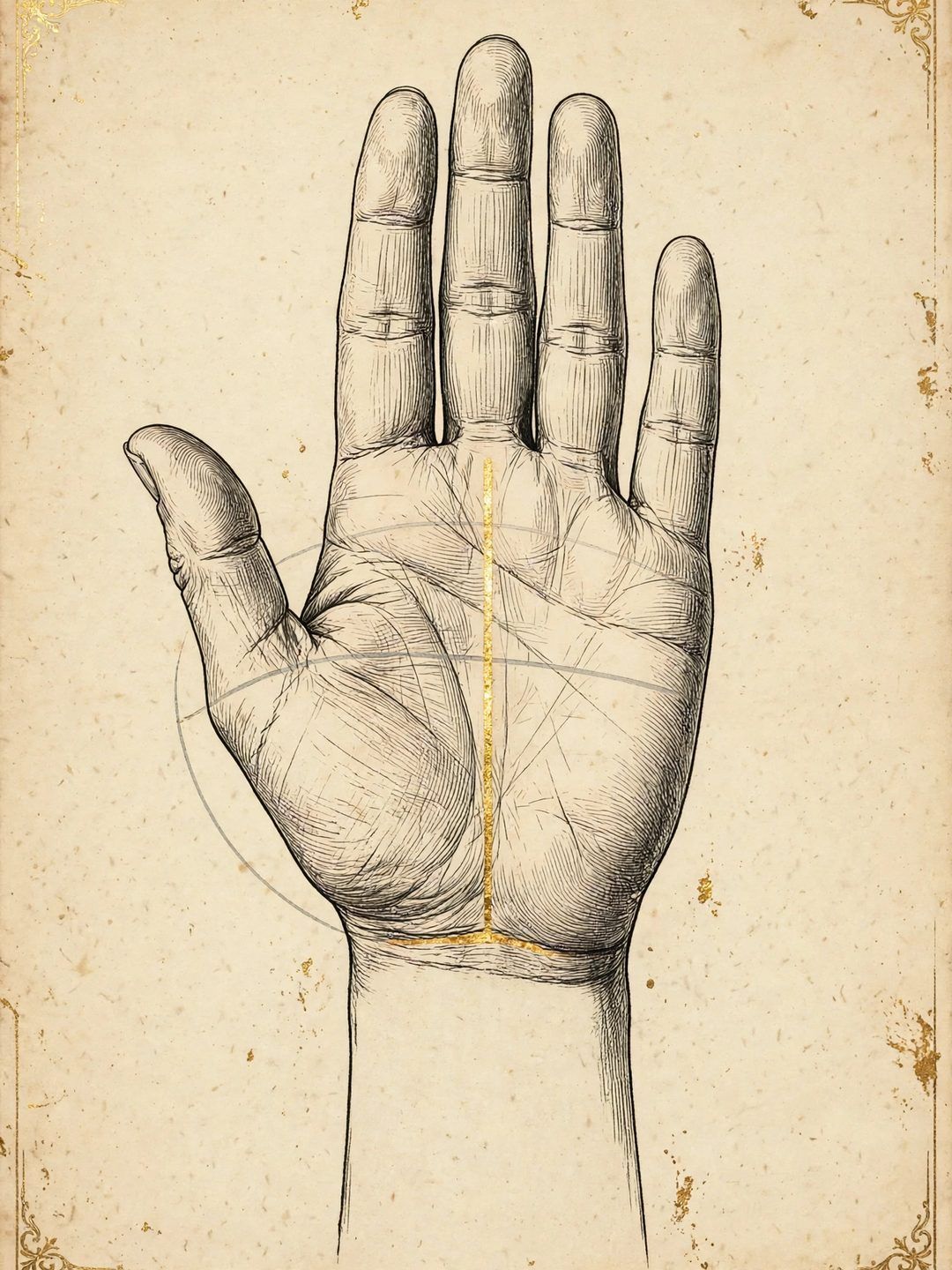
Look at the center of your palm. Search for a vertical line climbing toward your middle finger. If you find one, you've found the fate line. It's palmistry's career line, and it tells the story of your direction. It shows where your path comes from. It shows how much of it was chosen for you, and where the turns are. If you can't find one, don't worry, and don't stop reading. In this tradition, a missing fate line is one of the most interesting answers of all.
New to palm reading? The beginner's guide to palm reading lines maps every big line first. Your head line shows the thinking that steers this line's road.
Wondering about a friend's career path? Their palm may already say 👇
The Core Meaning
The fate line — also called the destiny line, the career line, or the Saturn line — runs vertically up the middle of the palm. It goes from somewhere near the wrist toward the mount below the middle finger. Unlike the life, heart, and head lines, which nearly everyone has, the fate line is optional. Some hands carry it deep and unbroken, from wrist to finger. Others show it in pieces. Many show none at all.
The old books read this line as your relationship with direction itself. A strong, straight fate line belongs to a life with a clear track. You felt certain about work early. Your path builds in one direction. Duties arrive on schedule. It's the line of the person who knew at sixteen what they'd be doing at forty — and is doing it. Its gift is momentum. Its shadow is a feeling some carriers report: the track was laid by someone else.
A fate line that starts late, breaks, or changes direction points to a path that corrects itself. Think of a false start, a reinvention, or a career built from chapters, not climbed like a ladder. And the absent fate line — the case beginners fear — means freedom. No track drawn means no track owed. Your life is steered by choice and opportunity, not by a plan. Many founders, freelancers, and serial career-changers carry exactly this hand. Palmistry does not grade the line. It describes how your direction gets made.
What This Line Reveals
Where your path comes from. The fate line's starting point shows the source of your direction. If it starts joined to the life line, your path is self-made, or built under strong family influence. If it starts from the lower, outer palm — the Mount of the Moon — your direction is shaped by the public. Travel shapes it too, and so do other people's needs and applause. If it starts in the middle of the palm, halfway up, that's a late start. Your path only becomes visible after the first act of life is over.
Career rhythm. The line's quality along its climb shows the rhythm of your working life. Deep and unbroken means a steady climb. A stretch of chain or faintness means scattered years. Work felt thin in meaning, even if the money was fine, and effort held it together. Breaks that restart offset — the line shifts sideways and goes on — mean deliberate changes of direction. That's the resignation, the retraining, the move to a new field.
Luck, and what the tradition actually means by it. Popular palmistry sells the fate line as a luck meter. But careful readers mean something subtler. The line shows how much of your path is carried by structure — institutions, patrons, timing, inheritance. And it shows how much you carry yourself. A strong line draws on structure. A faint or absent one runs on your own engine. Neither mix is luckier. They're different fuels. Knowing your fuel is the practical heart of this reading.
Common Variations & What They May Suggest
- Deep and straight from the wrist: The classic strong fate line — early direction, a steady climb, and a career that builds on itself. It means purpose you can point to, and duties that arrive early and stay.
- No fate line at all: The self-made hand. Your path is written by choices, not by a plan. You have freedom to pivot. Your work is built from desire and opportunity. Its shadow is drift. Its gift is that nothing about your direction is owed to anyone's script.
- Faint fate line: Direction is present, but lightly held. Your work matters to you, without ruling you. Or your calling is still warming up. This line often deepens in your thirties and forties, as your path settles.
- Broken fate line: The reinvention mark. A clean break with a restart means a career change at that life stage. You left the field. You started the business. You changed the country. Overlapping restarts mean transitions handled side by side. You began the new path before the old one closed.
- Double fate line: Two lines climb side by side. They point to a dual path: two careers, two incomes, or one great work carried next to the job that pays for it. You'll often see this on the hands of people whose real calling runs beside their day job.
- Starting from the life line: This means a self-made start, under strong family pull. Your path grows straight out of your own energy and early circumstances. Your success is credited to effort, not to doors opened by others.
- Starting from the Mount of the Moon: This means a path shaped by others. Think public-facing work, or a career fed by audiences, clients, travel, or a partner's world. Your direction arrives through people, not through plans.
- Ending early or stopping at the head or heart line: A fate line that stops at the head line is read as a path changed by a decision. One that runs to the heart line is read as a path changed by love, or by the heart overruling the plan. Readers treat these as chapter endings, not life endings. New lines often begin again above them, later in life.
Which Hand to Read & How
The fate line is where the two-hands rule pays off most. Read your writing hand for the path you're actually walking. That's the career your choices have built so far. Read your other hand for the path that was drawn first — the family trade, the expected profession, the direction your earliest world assumed for you. A strong fate line on one hand, and a broken or absent one on your writing hand, is a classic sign. It marks the person who left the family road and made their own. It's one of the most satisfying stories a reader gets to tell.
Timing on the fate line is read from the bottom up. The wrist is childhood. The crossing of the head line sits around the mid-thirties in most systems. The crossing of the heart line sits around the late forties to mid-fifties. So a break below the head line means an early-career change. A break above it means a midlife reinvention. Treat the ages as chapters, the way you would with the life line. Palmistry deals in seasons, not dates.
Search for this line with patience. It can be faint. It can sit off-center, or show in only one hand. A stretched palm can hide it completely. Relax your hand, and tilt it under the light. Look for any vertical line between your wrist and middle finger. Even a short one counts. Even its absence counts. Both are answers.
Cultural & Spiritual Symbolism
- Bhagya Rekha (India): In Samudrika Shastra, the fate line is the Bhagya Rekha. "Bhagya" means fortune or destiny. Indian readers weigh its starting point heavily. They read it beside the Sun line, its companion of fame and success. They judge a career by the pair, not by either line alone.
- The Saturn line (Western tradition): European chiromancy named it for Saturn, the planet of time, duty, and earned reward. Its mount sits under the middle finger. The name carries the tradition's core belief about this line. What it promises is not given. It is earned, bit by bit. Saturn pays slowly, and in full.
- Chinese palmistry: Chinese reading treats the center line as the career pillar of the hand. It reads the line's rise through the palm as the rise of a working life. Breaks and restarts stand for the reshuffles that every long career honestly contains.
- The line that changes: More than any other major line, the fate line is famous for changing across a life. It appears after a true calling is found. It breaks at reinventions. It deepens when a path locks in. Modern readers point to it as the best proof of their softer claim. The hand records direction. It does not dictate it.
What To Do With This Reading
Use the fate line as a direction check. Its questions are practical ones. Whose track are you on? And does it still fit? Once you've read your line, try the three moves below.
Ask the ownership question out loud. Strong line or none, the tradition's real test is the same. Strip away all expectations — your family's, your school's, the market's. Would you still choose this path? A strong fate line that answers yes is momentum. One that answers no is a very expensive habit. And this line, of all lines, gives you permission to notice.
Honor your breaks as data, not damage. Find the chapter where your line breaks, fades, or restarts. Name what actually happened. Most people discover their fate line has been telling the truth all along. The reading just gives them a way to read the map of a road they already walked.
If you have no fate line, build the ritual it replaces. Trackless hands thrive on chosen structure. Set a yearly direction review. Write a simple five-year sketch. Pick a date each spring to ask if the path still fits. A habit can replace the line you were not born with. And tradition would admit, that's the most fate-line thing imaginable.
See the rest of the map in the palmistry index. The life line's energy, the head line's judgment, and the heart line's weather are the three forces this line deals with on its climb.
Frequently Asked Questions
What does it mean if I have no fate line?
It's common, and readers do not treat it as bad luck. A missing fate line means a self-directed life. Your path is written by choices and opportunity, not by a fixed plan or an inherited track. Many founders, freelancers, and career-changers have no visible fate line at all.
What does a broken fate line mean?
A break means a change of direction at that stage of life. It could be a career change, a reinvention, or a move. If the line restarts, above all offset or overlapping, it suggests you absorbed the change. A new chapter of work began. Sometimes it began alongside the old one, before it closed.
Where does the fate line start and end?
It rises vertically through the center of the palm, toward the middle finger. It can start near the wrist, from the life line, from the lower outer palm, or halfway up the palm. Each start points to a different source of direction. Not everyone has one. And it may appear in only one hand.
What does a double fate line mean?
Two fate lines climbing together point to a dual path. That's two careers, two incomes, or one deep calling carried beside the job that pays for it. Readers also see it as support. It's a second structure holding your direction when the first one shakes.
Can the fate line appear or change later in life?
Yes. It's the most changeable of the major lines. Readers have long noted fate lines deepening when a true calling locks in. They break at reinventions. They can even appear in adulthood. That changeability is why modern palmistry reads this line as a record of direction, not a fixed destiny.
Related Palmistry Readings
First time reading palms? Browse the complete palmistry index.
Your path is one kind of sign. Your stars are another. Read about angel number 888 — the number of abundance earned in cycles. And meet Capricorn, the sign astrology gives to ambition and the long climb.
Palmistry readings on StarsToday explore traditional, cultural, and psychological perspectives — not facts, and never medical, mental-health, or professional advice. Palm lines cannot diagnose illness or measure how long you will live; if you have a health concern, speak with a qualified professional.