What Do the Lines on Your Palm Mean?
Open your hand, and look at it properly — perhaps for the first time. Across the skin runs a small map of creases. One curves around your thumb. Two cross the middle. One small line tucks under your little finger. Palmistry, the old art of palm reading, says those lines are not random. It reads them as a sketch of your energy, your feelings, your thinking, and the road your work takes. This guide walks you through the five lines that matter most, in plain words. You can start reading your own palm tonight.
Short on time? Start with the two lines everyone asks about first — your life line and your heart line.
Curious what your palm says? Send this to someone whose hand you know 👇
The Core Meaning
Palm reading rests on a simple idea. Your hands are the most used, most expressive part of you. The creases they carry form early, and change slowly across a lifetime. Readers in India, China, and later Greece and Europe built a whole language around those creases. In that language, a line is never a fixed sentence about your future. It's a tendency. It shows the direction your energy usually flows. It shows the way you usually love, think, and work.
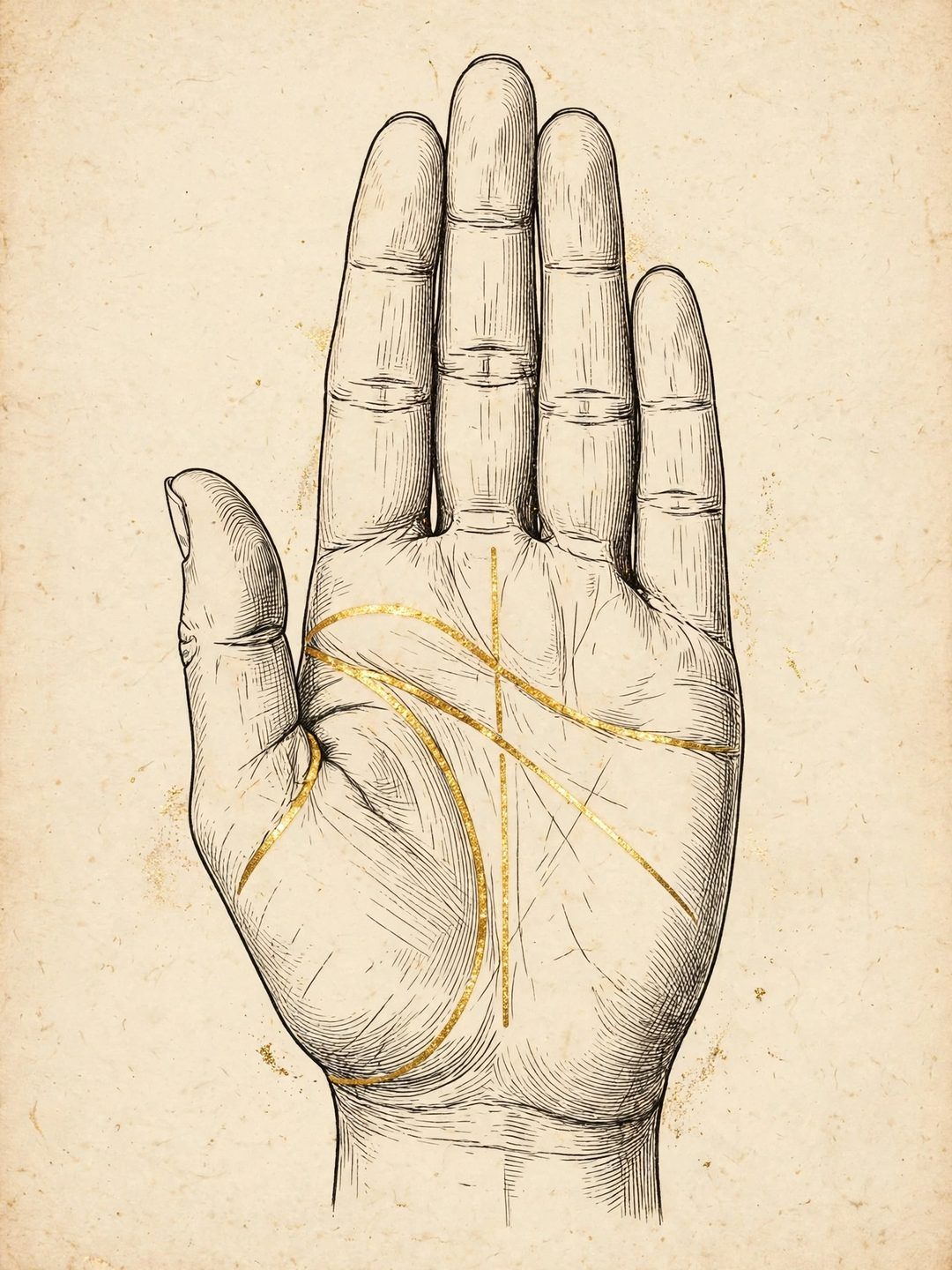
Five lines carry most of the reading. The life line arcs around the base of your thumb, and speaks of energy and big life changes. The heart line crosses the top of the palm, and speaks of love and feeling. The head line crosses the middle, and speaks of your mind. The fate line climbs the center toward your middle finger, and speaks of career and direction. The marriage lines sit under your little finger, and speak of your closest bonds. Learn where those five sit, and you can follow any palm reading, anywhere.
One warning belongs at the start, because it clears away the biggest myth in the whole subject. No line on your hand measures how long you will live. No honest reader claims one does. Palmistry at its best works like a mirror. It gives you a story about yourself, to test against your real life. And the testing is where the value sits.
What the Major Lines Reveal
The life line is the curve that wraps around the mound at the base of your thumb. Readers take its depth and sweep as your physical energy, and your love of life. A wide arc belongs to someone who throws themselves into experience. A line that hugs the thumb suggests a quieter, more guarded energy. Breaks and shifts along it are read as turning points — moves, changes of work, chapters ending and beginning. Read the full guide to your life line for the details.
The heart line is the topmost crease. It runs under your fingers, from the edge of the palm toward your index or middle finger. It's read as your emotional style — how openly you love, how much you show, and how you recover when love goes wrong. A line that curves up is read as warm and expressive. A straighter line is read as more private and controlled. Its ending point matters too. Under the index finger, between the fingers, or under the middle finger — each carries a different shade.
The head line runs beneath the heart line. It usually starts near the life line and crosses the palm. It's the map of your thinking. Length stands for depth of thought. Slope stands for imagination. Straightness stands for logic. A long, clear line suggests a mind that likes to finish its reasoning. A line that dives toward the wrist-side edge of the palm suggests a dreamer, whose ideas arrive as pictures. The famous "writer's fork" at its end is read as a mind that can hold two crafts at once.
The fate line is the vertical line — when it's present — rising from the lower palm toward the middle finger. It's the career line. Where it starts is read as where your direction comes from: family, yourself, other people, or a late start. Breaks along it are read as changes of path. Plenty of people have a faint fate line, or none at all. Readers do not treat that as bad luck. It's read as a self-made path, written by choices rather than by a plan.
The marriage lines are the short horizontal marks on the edge of the palm. They sit between the heart line and the base of the little finger. Despite the name, they're read as your significant emotional bonds, not as a wedding count. One deep, clear line is the classic sign of one great attachment. Several fine lines suggest a heart that has loved in chapters. Their height on the mount is traditionally used to guess at timing — lower for earlier bonds, higher for later ones.
Common Variations & What They May Suggest
- Deep and clear lines: The classic sign of strong, steady energy in that area of life. Readers treat a clean, unbroken line as the baseline of a settled trait. The quality it describes runs reliably in you.
- Faint or thin lines: A quieter version of the same story. A faint line is read as a tendency that sits in the background. It's present, but it's not the loudest voice in your character.
- Broken lines: A line that stops and restarts is read as an interruption, or a change of direction, in that area of life. Where the break sits matters. Readers divide the line into life stages, and place the change in the chapter where the break falls.
- Chained lines: A line made of small linked loops is read as energy that scatters or strains. It's a period, or a habit, of effort spread thin. On the heart line, it's linked with emotional sensitivity. On the head line, it's linked with a busy, restless mind.
- Forked lines: A split at the end of a line is read as a divided gift. It can mean two directions, two talents, or a choice between two ways of living that part of your life. Forks at the start are read as influences that joined early.
- Islands on a line: A small loop that splits and rejoins is read as a pocket of difficulty, or low energy, in that chapter. It's a stretch where the quality of the line was tested. Readers always check what the line does after the island. A line that resumes strongly is read as recovery.
- Lines that differ between your hands: Completely normal — and one of the most-read features of all. The difference itself is the message. The hand you were born with shows one version of you. The hand you've lived with shows what you've done with it.
Which Hand to Read & How
Beginners always ask the same question: which hand? The most common modern answer is simple. Read the hand you write with first — your dominant hand. It shows your present life: your current habits, choices, and direction. Then read your other hand. Tradition calls it the hand of inheritance. It shows your starting point, your natural tendencies, and the private, inner version of you.
Older traditions sometimes split it by gender — the left hand for women, the right for men, in classical Chinese reading. But most working readers today use the dominant-hand rule for everyone. They treat the pair of hands as a before-and-after. When a line is stronger on your dominant hand, the trait is read as developed. When it's stronger on the other, it's read as a gift you haven't fully used yet.
To read your own palm, sit somewhere bright. Open your hand flat, but relaxed — a forced, stretched palm distorts the lines. Start with the three big creases. Find the life line's arc, the heart line under your fingers, and the head line below it. Then look for the fate line climbing the center. Turn your hand sideways for the marriage lines under the little finger. Read depth first, then shape, then markings. And read gently. You're sketching tendencies, not grading yourself.
Cultural & Spiritual Symbolism
- Samudrika Shastra (India): Palm reading in India sits inside Samudrika Shastra, the ancient study of bodily signs. The hand lines carry Sanskrit names — Jeevan Rekha (life), Hridaya Rekha (heart), Mastishk Rekha (head), Bhagya Rekha (fate). The hand is treated as a text given at birth, and revised by karma and choice alike.
- Chinese palmistry: One of the oldest systems, built on three great lines. The life line is the earth line. The head line is the human line. The heart line is the heaven line. Chinese reading weaves the lines together with the five elements, and the mounts named for them. It's also the source of the classical hand rule — left for women, right for men.
- Greek and European chiromancy: Aristotle is said to have written on the lines of the hand. Chiromancy travelled through Rome into medieval Europe, where it mixed scholarship with fortune-telling at fairs. In the late 1800s, the Irish reader Cheiro made palmistry famous across Europe and America. He read the hands of kings and writers.
- The modern reading: Today's readers mostly blend the traditions, and soften the claims. The lines are treated less as fate, and more as a language for self-reflection. That's closer to how StarsToday treats dreams and angel numbers — symbolic, personal, and honest about its limits.
What To Do With This Reading
Keep it playful, and keep it honest. A palm reading is a starting point for reflection, not a verdict. Once you've found your five lines, try the three moves below.
Read both hands before you judge any line. One hand shows the story you inherited. The other shows the story in progress. The gap between them is usually the most interesting part of the whole reading. It's where your choices live.
Take one line and test it against your real life. Pick the line that surprised you most. Ask whether the traditional reading matches the person you know yourself to be. Where it matches, you've learned a symbol. Where it doesn't, you've learned something better — where the mirror is wrong about you.
Photograph your palms once a year. Lines do change — slowly, over years, as small lines deepen and faint ones fade. A yearly photo turns palm reading from a one-off curiosity into a quiet record of how you're changing. That's the healthiest way to use it.
Ready to go line by line? Browse the complete palmistry index. From your life line to your marriage lines, each guide takes one line slowly and in full.
Frequently Asked Questions
What are the main lines in palm reading?
Five lines carry most of a palm reading. They are the life line (energy and life changes), the heart line (love and emotion), the head line (thinking and decisions), the fate line (career and direction), and the marriage lines (your closest bonds). The first three appear on nearly every hand. The fate line and marriage lines vary much more.
Which hand should I read in palmistry?
Start with the hand you write with — your dominant hand. It's read as your present life, and the choices you're actively making. Your other hand is read as your inheritance: your natural tendencies and starting point. Comparing the two is where most readers find the real story.
Can palm lines really predict the future?
No honest reader claims they can. Palmistry is a symbolic tradition, not a tested science. No line measures your lifespan, or fixes your future. Its value is reflective. The lines give you a structured way to think about your energy, your feelings, and your direction. And the decisions stay yours.
Do palm lines change over time?
Yes, slowly. The deep main creases form before birth, and stay broadly stable. But smaller lines can deepen, fade, or appear across the years, as your hands and habits change. That's why long-time readers suggest comparing photos of your palms taken years apart. Don't expect change week to week.
What if I do not have a fate line?
It's common, and readers do not treat it as bad luck. A missing or faint fate line is read as a self-directed path. It's a life steered by personal choices, rather than by a single fixed calling. Many people who change careers, or build their own work, have exactly this hand.
Related Palmistry Readings
New to the craft? Browse the complete palmistry index.
Your palm is one map. Your birth chart is another. See what angel number 1111 is said to mean for new beginnings. And meet Gemini — the sign astrology links with the hands themselves.
Palmistry readings on StarsToday explore traditional, cultural, and psychological perspectives — not facts, and never medical, mental-health, or professional advice. Palm lines cannot diagnose illness or measure how long you will live; if you have a health concern, speak with a qualified professional.