What Do Your Marriage Lines Mean in Palmistry?
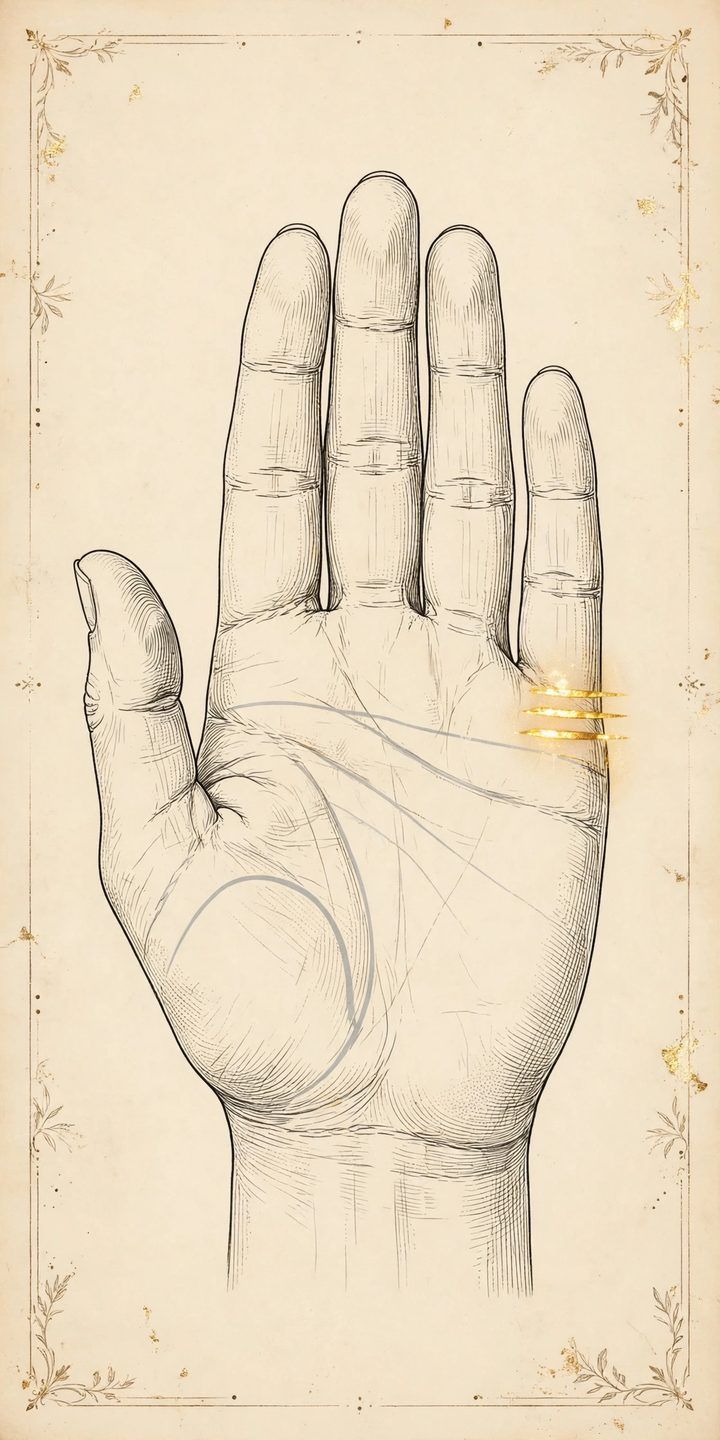
Make a loose fist, and look at the edge of your hand, under your little finger. Somewhere between that finger and your heart line sit one or more short horizontal marks. It's the most asked-about centimetre in all of palmistry. These are the marriage lines. But the old readers were more honest than the name. They read them as lines of deep attachment — the bonds that shape a life, whether or not a ceremony ever blessed them. Here is what yours are said to mean, counted carefully, and read without the fortune-teller's exaggerations.
First, find the neighborhood: the beginner's guide to palm reading lines maps the whole palm. The heart line directly below tells the bigger story of how you love.
Counted yours? Send this to someone whose lines you wonder about 👇
The Core Meaning
The marriage lines live on the Mount of Mercury. That's the small padded area under your little finger. The lines run in from the edge of the palm. Most hands show between one and three clear lines. Finer marks sit around them, and readers politely ignore those. Only lines with real depth are counted. That rule saves beginners from reading every skin crease as a wedding. The tradition's core claim is modest. These lines mark your capacity for deep, committed attachment. They mark the few bonds strong enough to reshape a life.
One deep, clear, unbroken line is the classic sign. It means one great attachment, given with your whole heart. It doesn't have to mean one marriage and no other loves. Readers take it as one bond that matters above the rest — the relationship a life is built around. Two clear lines mean two significant chapters of the heart. Sometimes that's two marriages. Sometimes it's one marriage split by a change so deep, it reads as two.
What the lines do not do is keep a census. The popular claim says each line equals one marriage. That claim is exactly the kind of fortune-telling that gives palmistry its doubters. Plenty of once-married people carry two lines. Plenty of twice-married people carry one. Read the lines as a sketch of how you bond. Early or late, once or in chapters, steadily or stormily — read them that way, and they reward you. Read them as a wedding register, and they'll lie to you with a straight face.
What This Line Reveals
Timing, in the tradition's rough geography. The strip of skin between the heart line and the little finger is read as a timeline. Lines sitting low, close to the heart line, mean early bonds — the loves of youth, traditionally before the mid-twenties. Lines in the middle suggest the late twenties and thirties. Lines placed high, near the finger, mean love that arrives later. It's chosen with full knowledge of its cost. Treat the ages as scenery, not scheduling.
The shape of the bond. A long line that runs well onto the mount means a lasting, influential partnership. A short line suggests a bond that was real but brief. Or it means a deep attachment that never became a shared life. A line that curves gently upward means a bond that lifts you. The much-discussed downward curve dips toward the heart line. The old reading takes it as sorrow inside a bond — a partner's hard chapter, carried together. It does not mean a scheduled tragedy, as frightened readers fear.
Your pattern across a lifetime. Read together, the set of lines sketches your romantic pattern. One clear line among faint ones suggests many attractions, and one true harbour. Several lines of equal depth suggest a heart that commits fully more than once. A mount with almost no lines at all has a kind reading. It points to a person whose deepest attachments run to work, family, or friendship, rather than to romance.
Common Variations & What They May Suggest
- One deep, clear line: The classic reading — one great attachment that organizes a life. Depth and clarity carry the meaning. It's a bond fully entered, with nothing held back.
- Two clear lines: Two significant chapters of the heart. These mean two deep bonds across a lifetime. Or they mean one bond split into before-and-after by a change so large, it counts as a second beginning.
- Three or more clear lines: This is a heart that has loved in chapters. Or one whose feelings divide among romance, family, and calling. Older books moralized here. Modern readers simply note a rich, full emotional life — and check the heart line for the fuller story.
- Many fine, faint lines: Attractions, crushes, and almosts. Readers count only the deep lines as bonds. A spray of faint ones means a romantic nature that feels often and lightly. It does not mean a crowd of marriages.
- Forked at the start: A fork where the line enters from the palm's edge means a bond that begins apart. Think distance, delay, or two lives that took time to join, before the shared story started.
- Forked at the end: A split toward the inner end is read as a parting of ways late in a bond. Two people grow in different directions. A narrow fork is read more gently. It means differences of view inside a bond that otherwise holds.
- Broken marriage line: A break means an interruption inside a significant bond. It could be a separation, a crisis, or a chapter of living as strangers. If the line restarts and overlaps, readers read repair. It's the same bond, resumed on new terms.
- Curved downward toward the heart line: The most feared shape, and the most exaggerated. The careful old reading takes it as a bond that carries sorrow or heavy duty. Often, one partner supports the other through a hard season. It's not a prediction of loss.
- Small vertical lines rising from a marriage line: The famous children lines. Fine upright marks above a marriage line stand for children deeply connected to that bond — born, adopted, or mentored. Readers count their depth, not their number. They treat the whole subject as the softest reading on the hand.
Which Hand to Read & How
Marriage lines are small, and small lines demand honest method. Read your writing hand for the bonds your lived life actually holds — the attachments you've chosen and kept. Read your other hand for the pattern you inherited. That's the template of loving you absorbed early, sometimes before you chose anything at all. When your writing hand shows one clear line, and your other hand shows several, readers tell a story. It's the story of a heart with a crowded past that chose, in the end, one harbour.
To see the lines properly, curl your fingers slightly. Turn the edge of your hand to the light. The lines hide when the palm is stretched flat. They show themselves when the mount relaxes. Count only lines with genuine depth and length. Ignore hairline scratches of skin — every hand has them, and no reader reads them. Then check the set against the heart line below. The marriage lines tell you about bonds. The heart line tells you about the lover. And the second reading always corrects the first.
One tradition note, for completeness. Some classical Chinese reading assigns the left hand to women and the right to men, for all lines, marriage lines included. Most modern readers have set that rule aside. They use the dominant-hand method for everyone. The hand you live with tells the life you're living, whichever hand it is.
Cultural & Spiritual Symbolism
- Vivah Rekha (India): In Samudrika Shastra, the marriage line is the Vivah Rekha. "Vivah" means wedding. It's among the most consulted lines in Indian palmistry. Family and reader alike study it for the timing and quality of a match. The children lines rising from it belong to the same hopeful reading.
- Lines of union (Western tradition): European chiromancy preferred the name "lines of union" or "lines of affection." It's a wider and wiser title. The tradition always read them as deep attachments of every kind. Marriage was simply the most formal shape such a bond could take.
- The Mount of Mercury: The lines sit on the mount named for the god of travellers, messages, and exchange. In the old symbolism, it's a fitting address for the negotiations of the heart. It stands for what two people promise, trade, and carry between them across a shared life.
- Children lines in folk tradition: In European and Asian folk palmistry alike, the fine vertical lines above the marriage line were read as children. It was the one reading nearly every client asked for. Careful readers have always given it most softly. It's a symbol of bonds with the young, not a count of cradles.
What To Do With This Reading
Hold this reading more lightly than any other on the hand. These are small lines with a big reputation. Their healthy use is reflection, never decision. Once you've counted and read yours, try the three moves below.
Never make a relationship decision from a line. Not a proposal accepted. Not a partner doubted. Not a wedding timed. If a reading ever pushes you toward a real-life choice about a real person, put the hand down. Use your heart and head instead — the two lines below this one, which exist for exactly that purpose.
Read the set as your pattern, and ask if it still serves you. One line, several lines, none — the useful question is simple. Is the pattern the mount describes the pattern you want to keep? People change their loving across a lifetime. And these fine lines are among those that change with them.
Give the children lines the softness the tradition intends. If you find them, let them stand for the young lives you'll matter to, in whatever way they arrive. If you don't find them, remember this. Generations of readers treated their absence as meaningless. Skin is skin. And a family's shape is not written in anyone's palm.
Round out the story in the palmistry index. The heart line below explains how you love. The fate line explains where your path runs. And the two readings together are worth ten of this one alone.
Frequently Asked Questions
How many marriage lines do I have, and how do I count them?
Make a loose fist. Look at the edge of your hand under your little finger, between that finger and the heart line. Count only the lines with real depth and length. Most hands show one to three. Ignore fine skin creases. Every hand has them, and no reader reads them as bonds.
Does each marriage line mean one marriage?
No. That's the popular version, not the traditional one. The lines stand for your significant deep attachments, and the chapters of your bonding life. Once-married people often carry two lines. Twice-married people sometimes carry one. The set sketches your pattern of loving, not a register of weddings.
What does a forked marriage line mean?
A fork at the outer edge, where the line enters the palm, means a bond that began apart. Think distance, or delay, before two lives joined. A fork at the inner end means a parting of directions late in a bond. A narrow fork suggests differences within a bond that otherwise holds.
What are the children lines in palmistry?
They are the fine vertical lines that rise from a marriage line, on the edge of the palm. The old books read them as children closely bound to that relationship — born, adopted, or mentored. Readers stress that this is the softest reading on the hand. It's a symbol of connection with the young, never a reliable count.
What if I have no marriage lines?
A clear mount with no deep lines points to a heart whose deepest attachments run elsewhere. They may run to work, family, friendship, or a calling. Or it marks a person who guards their bonding capacity for one late, deliberate choice. It's not read as a sentence of loneliness. Many happily partnered people show faint lines here.
Related Palmistry Readings
First time reading palms? Browse the complete palmistry index.
Bonds are one kind of sign. Numbers are another. Read about angel number 1212 — the number of partnership growing step by step. And meet Taurus, the sign astrology gives to loyalty and lasting love.
Palmistry readings on StarsToday explore traditional, cultural, and psychological perspectives — not facts, and never medical, mental-health, or professional advice. Palm lines cannot diagnose illness or measure how long you will live; if you have a health concern, speak with a qualified professional.