What Does Your Heart Line Mean in Palmistry?
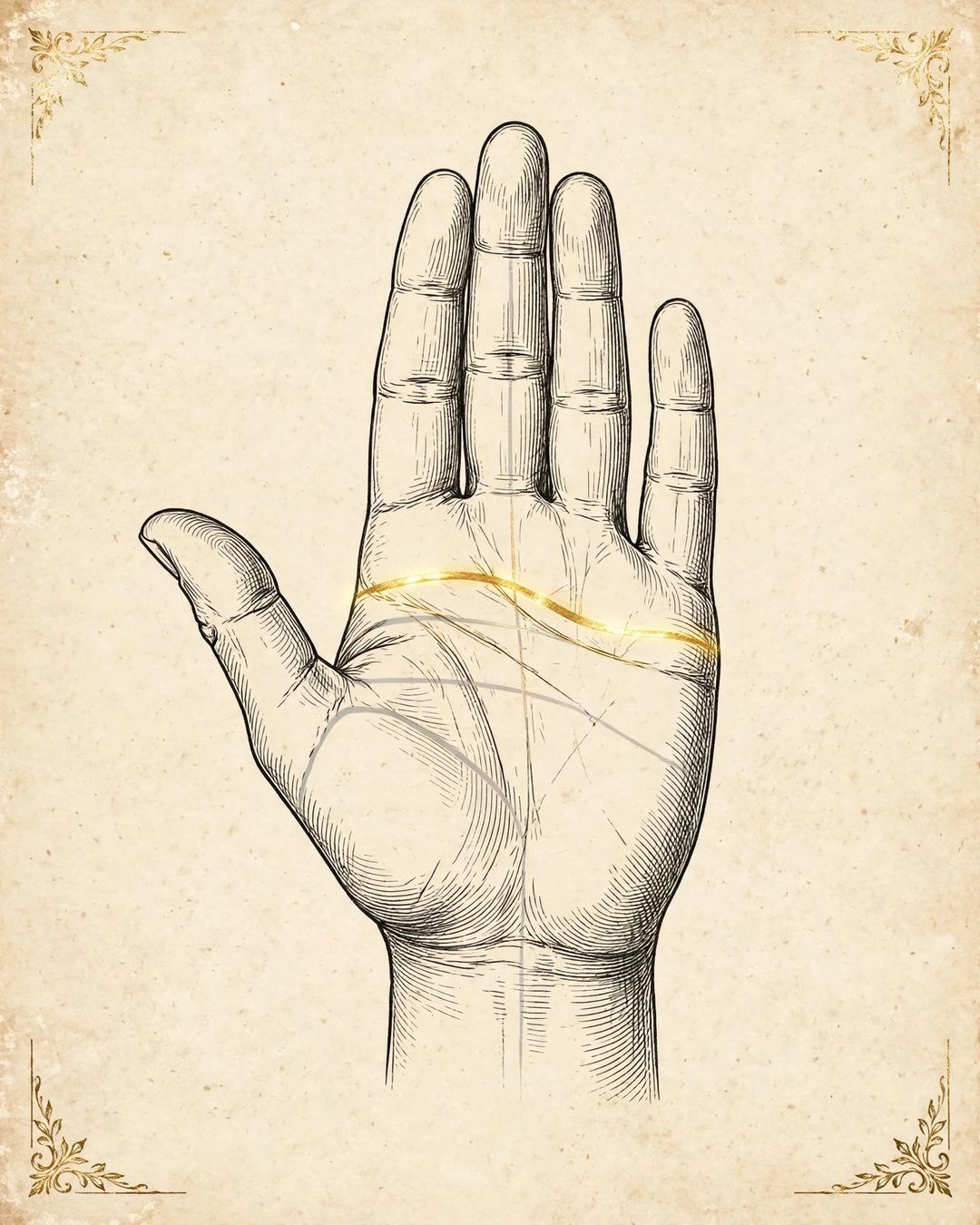
Run a finger along the top of your palm, just under your fingers. You'll find the line that palmistry asks about love. The heart line shows your emotional style. It shows how openly you love, and how much of your heart you let people see. It also shows how you heal when love costs you. Curved or straight, long or short — its shape tells how you give love, and how you guard it. This guide reads the line the way the old readers did. It ends with what the line can tell you about yourself.
First time? The beginner's guide to palm reading lines maps every big line. The marriage lines sit just above this one, on the same mount.
Reading palms with someone you love? Send them this 👇
The Core Meaning
The heart line is the top crease on your palm. It starts at the edge of your hand, below your little finger. It runs toward your index and middle fingers. Palmistry reads it as your emotional style, written in skin. A long line that curves gently upward is the classic sign of a warm, open heart. This is someone who loves out loud. They forgive face to face. Their feelings sit where people can see them.
A straighter, flatter heart line tells a different story. It points to a more private, thoughtful heart. The feelings are real, but you keep them under control. You show love in acts, not in big speeches. You hand out trust slowly, to a few people, once they've earned it. Readers are careful here — straight does not mean cold. Many of the most loyal hands in the tradition carry a level heart line. Their love is simply quieter, and it lasts.
Where the line ends adds more detail. If it ends under your index finger, it points to idealistic love — high hopes, honestly held. If it ends between the index and middle fingers, that's the balanced form. Heart and head work as partners. If it ends under your middle finger, it points to a heart that guards itself more. It learned, sometimes the hard way, to hold something back. None of these is a verdict on your future happiness. They describe your weather. And you can always dress for the weather.
What This Line Reveals
How you love. The heart line first shows your giving style. A deep, clear line points to feelings that run strong and steady. You commit fully, and you feel fully. A line that rises toward the fingers points to love that needs to be shown — through touch, words, and being there. A line that stays low and straight points to love proven by reliability. It's the lift to the airport. It's the bill quietly paid. It's showing up.
How you recover. Breaks, chains, and islands on the heart line are a record of hard times. These are chapters where love hurt, trust was tested, or your heart ran tired. Readers look at what comes after the mark. A line that breaks, then runs deep and clear again, is a special sign. It points to someone who loved again after a loss. Readers respect that shape more than any other on this line.
How you balance heart and head. The heart line does not sit alone. Palmistry reads it against the head line below it. When the heart line is the stronger of the two, feelings lead and logic follows. When the head line is stronger, reason keeps the heart in check. Then there's the rare simian line, where heart and head merge into one crease. It points to pure intensity. You feel and think in a single motion. You're all in — in love, and in everything.
Common Variations & What They May Suggest
- Curved heart line: The open, expressive form. It shows warmth and romance, and love that needs to be shown to be believed. A curve that sweeps high toward the index finger means you give freely in love. A gentler curve means warmth with steadiness.
- Straight heart line: The controlled form. You keep your feelings private. You show love through loyalty and acts. This heart chooses with care, commits slowly, and never performs emotion for an audience.
- Long heart line: A line that reaches well across the palm points to a heart with a wide reach. You can attach deeply, and you feel strongly for others. There's a shadow side, though. If the line runs with no breaks or boundaries, you may give past the point of wisdom.
- Short heart line: A line that ends early points to a more self-contained emotional life. You form fewer, deeper attachments. Or you have a heart that protects its center and opens rarely. It's not a lack of love. It's a smaller, guarded circle for it.
- Forked at the end: A split where the line finishes points to a heart that balances two pulls. One pull is emotion, the other is practicality. Or it's love held next to clear-eyed realism. The famous three-pronged fork means balance among love, logic, and common sense.
- Broken heart line: A clean break is read as a turning point in your love life. It could be a great love, a great loss, or the moment your way of loving changed. A break that overlaps and restarts means healing in progress. The story continues on new terms.
- Chained heart line: A line built of small linked loops points to a sensitive, changeable heart. Your feelings rise and fall. You've had many emotional chapters, and you feel everything at full volume. In a mature hand, this often settles into depth. Sensitivity grows into understanding.
- Islands on the heart line: A small loop that splits and rejoins points to a pocket of strain. It could be a time of worry, grief, or a relationship under pressure. Its place along the line puts it in one chapter of your life. A clear line after it means your heart came back to itself.
Which Hand to Read & How
Read the heart line on your writing hand for the heart you live with now. That's the loving style your choices and life have built. Read your other hand for the heart you were born with. It shows your earliest emotional weather, often set in your first home. When the two differ, readers tell a hopeful story. Say the line is chained on one hand and clear on the other. That means a sensitive start, steadied by living.
Notice one more thing. Readers read this line from the edge of the palm inward. They judge its ending against the fingers above it. Find where your line truly finishes. Does it end under the index finger? Between the index and middle? Or under the middle? That one detail changes the reading more than any other. Then check its height. A heart line that sits high, close to the fingers, means the heart leads the life. One that sits lower leaves more room for the head.
As with every line, use bright light and a relaxed hand. Don't stretch the palm. Compare both palms before you conclude anything. And hold the reading lightly. The heart line describes patterns in how you love. It doesn't grade your past. It doesn't sentence your future.
Cultural & Spiritual Symbolism
- Hridaya Rekha (India): In Samudrika Shastra, the heart line is the Hridaya Rekha. It's the line of the heart — both the organ and the seat of feeling. Indian readers weigh its ending point and its branches with care. Branches that rise mean love that flourishes. Branches that fall mean love that has known disappointment.
- The heaven line (China): Chinese palmistry calls the heart line the heaven line. It's the highest of the three great lines. It's tied to spirit and feeling, not to body or reason. Its quality shows the state of your emotional skies — clear weather, or interesting weather.
- European chiromancy: Medieval and Renaissance readers treated the heart line as the first line of the hand. They read it for love, devotion, and the feelings of the heart in every sense. They prized the fork at its end. It was the mark of a balanced soul — feeling guided by wisdom.
- The simian line in world tradition: On some hands, heart and head fuse into a single crease. You find it on a small share of hands everywhere. Traditions split on its meaning. Some read it as a blessing of focus and intensity. Others read it as a warning of all-or-nothing loving. Modern readers take the middle road. Intensity, handled with care, is a gift.
What To Do With This Reading
The heart line is a mirror for your emotional style. And mirrors are for adjusting, not for judging. Once you've read your line, try the three moves below.
Name your giving style — and let it be a style, not a flaw. If your line is straight and private, stop saying sorry for loving quietly. Tell your people once, plainly, that your love shows in acts. If your line is curved and expressive, own the volume. Just check that your giving has a floor as well as a ceiling.
Read your breaks with respect. Almost every adult hand carries a mark on this line. Find yours, and name the chapter it belongs to. The tradition never asks, "why did this happen to you?" It asks, "what did the line do afterwards?" A heart that continued is the whole point.
Compare hands before you compare yourself to anyone. Your two heart lines are a before-and-after of your own emotional growth. That comparison — yours, not a stranger's — is the only one this craft honestly offers. And it's usually a kind one.
Keep exploring the map: browse the complete palmistry index. It covers your life line's energy, your head line's thinking, and the marriage lines that sit near this line.
Frequently Asked Questions
What does a straight heart line mean?
A straight heart line points to a private, controlled emotional style. Your feelings are real, but you manage them. You show love through loyalty and practical acts, not grand speeches. It does not mean a cold heart. Many readers see it as the sign of steady, lasting love.
What does a broken heart line mean in palmistry?
A break in the heart line is read as a big turning point in your love life. It could be a great love, a loss, or the moment your way of loving changed. If the line restarts clearly, or overlaps as it restarts, it means healing. Your heart continues on new terms.
Where does the heart line start and end?
The heart line starts at the edge of the palm, below the little finger. It runs across the top of the palm. Where it ends matters most. Under the index finger means idealistic love. Between the index and middle fingers means balanced love. Under the middle finger means a more guarded heart, one that protects itself.
What is a chained heart line?
A chained heart line is built from small linked loops, instead of one clean crease. It points to a sensitive, changeable emotional nature. Your feelings run at full volume, and they shift like weather. In many hands, it settles with age into depth and real understanding.
What if my heart and head lines are joined in one line?
That single crease is called the simian line. It appears on a small share of hands. It points to intensity. Thought and feeling are fused, so you feel both in one motion. Traditions differ on it. But modern readers treat it as a mark of focus and all-in commitment, not a warning.
Related Palmistry Readings
First time reading palms? Browse the complete palmistry index.
Lines are one kind of sign. Numbers are another. Read about angel number 222 — the number of balance and partnership. And meet Libra, the sign astrology gives to love and harmony.
Palmistry readings on StarsToday explore traditional, cultural, and psychological perspectives — not facts, and never medical, mental-health, or professional advice. Palm lines cannot diagnose illness or measure how long you will live; if you have a health concern, speak with a qualified professional.