What Does Your Head Line Mean in Palmistry?
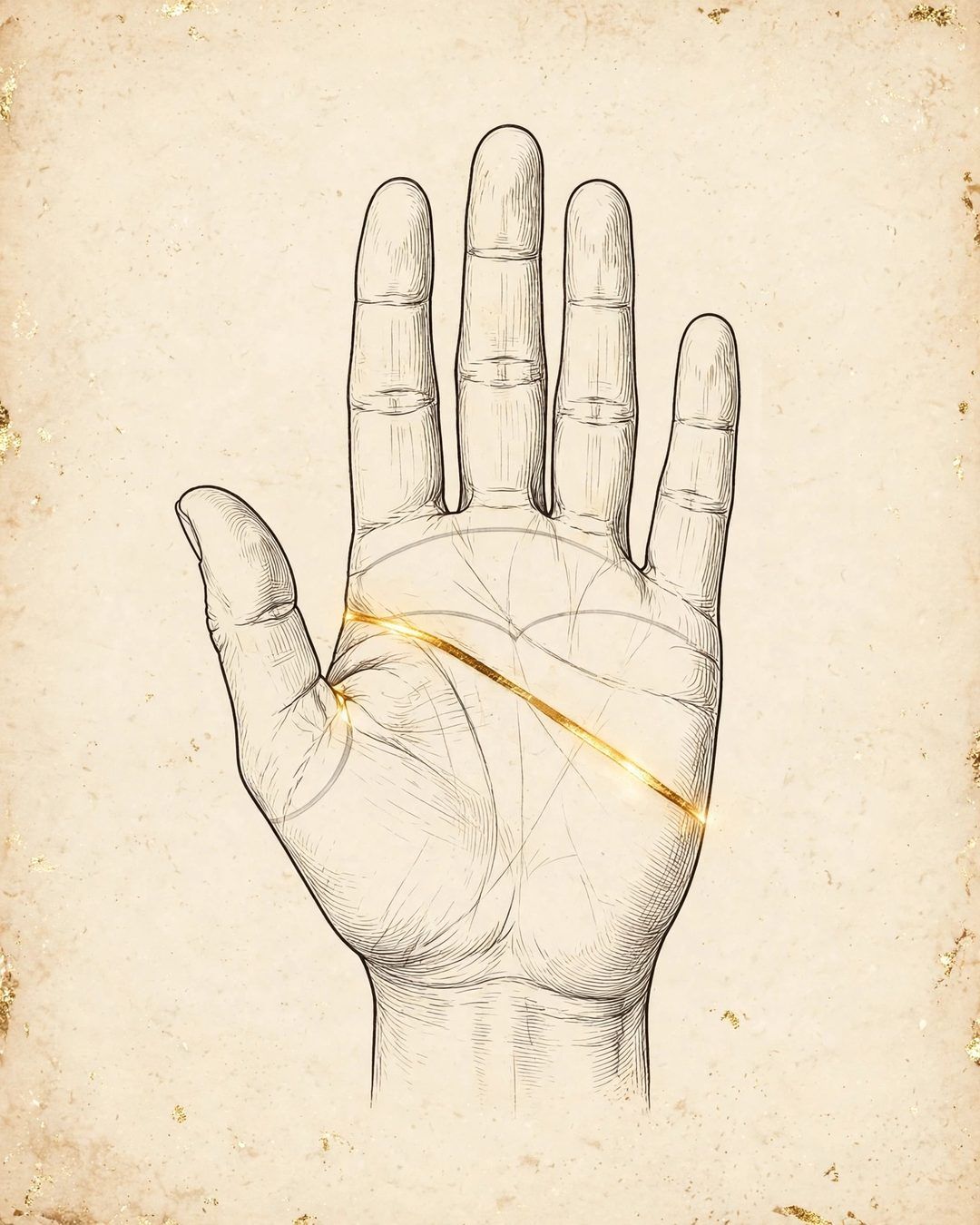
If the heart line shows how you love, the head line shows how you think. Palmistry counts it as one of the most important lines on the hand. It runs across the middle of your palm, beneath the heart line. Readers look at its length, its slope, and its ending. Together, they map your mind — logic against imagination, focus against curiosity, how you decide and how you learn. Before you read yours, clear away its one big myth. A short head line has never meant a small mind.
New to palm reading? The beginner's guide to palm reading lines maps the whole hand. The head line starts right next to your life line.
Know a deep thinker — or a happy dreamer? Send them their line 👇
The Core Meaning
The head line — older books call it the line of wisdom — begins at the edge of the palm, between thumb and index finger. It starts very close to the life line, and runs across the middle of the hand. Palmistry reads it as your thinking style, in one crease. A long, straight, clear line is the classic sign of an analytical mind. This person reasons in order. They finish their arguments. And they trust a conclusion they can trace back, step by step.
A head line that curves or slopes downward tells the other great story. The further it dives toward the lower, outer palm — the area readers call the Mount of the Moon — the more imaginative the mind. This thinker works in pictures, stories, and possibilities. Their ideas arrive whole, not built piece by piece. Neither slope is better than the other. The straight line builds bridges. The sloping line imagines where bridges could go. Every team needs both.
Length, meanwhile, is about interest, not ability. A long head line belongs to a mind that likes to stay with a subject. It turns the subject over, researches it, and thinks in depth before it decides. A short head line belongs to a mind that decides fast and thinks in essentials. It's practical, direct, and bored by ceremony. The myth that short means unintelligent is the one error every tradition agrees on rejecting. Some of the sharpest, quickest minds in the reading room carry the shortest lines.
What This Line Reveals
Decision style. The head line shows how you make decisions. A line joined to the life line at its start points to careful choices. You think of family and consequences first. Your mind checks before it leaps. A line that starts apart, with clear space from the life line, points to independence. You decide fast and trust yourself. Sometimes there's a gambler's edge, and a good reader will gently point it out.
Learning style. Depth and clarity show concentration. A deep line belongs to a mind that can hold a subject. A faint one belongs to a mind that samples widely and fixes on what glows. Breaks and chains along the line point to chapters where thinking was strained. That could be overload, distraction, or a decision made under pressure. A line that grows deep again afterwards points to a mind that found its footing.
Career leanings. Readers tie the line's shape to the work it suits. Straight and level points to analysis, craft, systems, law, and numbers. In those fields, the answer matters more than the performance. Sloping points to writing, design, music, and healing. In those fields, the answer arrives as an image first. The forked ending — the writer's fork — is the much-loved middle case. It's a mind built to hold a practical trade and a creative one at the same time.
Common Variations & What They May Suggest
- Long and straight: The analyst's line — thorough, logical, and retentive. This mind thinks in depth and detail. It finishes its reasoning. And it's hard to rush into a conclusion it hasn't checked for itself.
- Short head line: The essentialist's line — fast, practical, and concrete. This mind cuts to the working part of a problem. It decides with what it has. Its shadow is haste. Its gift is speed.
- Sloping or curved: The imagination line. The gentler the slope, the more creativity mixes with practicality. The deeper the dive toward the Moon mount, the more the mind lives in image, mood, and invention. It's the artist's and the storyteller's sign.
- Forked ending (writer's fork): The line splits at the end — one branch level, one sloping. It means two kinds of thinking in one mind: the practical and the inventive. It's long been linked with writers, teachers, and anyone who earns by explaining.
- Joined to the life line at the start: This points to a careful, considered beginning. Family influence is strong. You weigh decisions before you take them. Your confidence grows with evidence. The longer the join, the later independence comes. And the more deliberate it tends to be.
- Separated from the life line: A clear gap at the start points to early independence and a taste for risk. This mind trusts its own first instinct. It acts before the committee meets. It learns from outcomes, not from warnings.
- Broken or chained head line: Breaks in the line point to chapters of mental strain. These are times when concentration cost more than it should. Or a decision came along that split the story. A chained start is common in studious hands. In many adults, it settles into a clear, strong line.
- Wavy head line: A line that rises and falls as it crosses points to a restless, ranging mind. It connects unlike things fast. It gets bored by straight corridors. It suits work that changes shape often.
Which Hand to Read & How
Read your writing hand for the mind you use now. That's your trained, practiced thinking, shaped by your schooling and your work. Read your other hand for the mind you were born with. It shows your raw learning style, before life trained it. A straight line on one hand, and a sloping one on the other, is a favorite story among readers. It tells of a born analyst who grew an imagination. The reverse is the craftsperson who taught a dreamer discipline.
To judge length honestly, compare the line against your own palm. Don't compare it with another person's hand. A head line that reaches under the ring finger is medium. One that stretches toward the little finger is long. One that stops under the middle finger is short. Judge the ending, too. A line that stops cleanly reads differently from one that fades into a fork, or a spray of fine lines. Readers take that spray as thought scattering into many interests at once.
And read the start with care. The join with the life line carries real weight in this line's story. Look closely, under bright light. Many joins that look fused are really two lines running together for a few millimetres, before they part. That's the exact picture of a person who started careful, then struck out on their own.
Cultural & Spiritual Symbolism
- Mastishk Rekha (India): In Samudrika Shastra, the head line is the Mastishk Rekha, the line of the brain and intellect. Indian readers weigh its clarity, and its start against the life line. They honor the forked ending. It's the mark of a mind that can serve both the material world and the creative one.
- The human line (China): Chinese palmistry puts the head line at the center of its three great lines, and calls it the human line. It's the line of the self, between the earth line below and the heaven line above. Its state shows the state of your reasoning self, between body and spirit.
- European chiromancy: Medieval readers called it the line of wisdom. They read it for judgment, memory, and sound advice. When a king chose an adviser, his palmists were asked about this line before any other. The writer's fork took its modern name and fame in this tradition.
- The simian line, from the mind's side: Where head and heart fuse into one crease, the mind's story changes completely. Thought and feeling arrive as one act. Traditions around the world noted it. Some read it as a mark of genius-like focus. Others read it as a warning. Modern readers see it as single-pointed intensity that must be aimed with care.
What To Do With This Reading
The head line works best as a user manual for your own mind. It won't tell you what to think. It sketches how you think best. Once you've read your line, try the three moves below.
Work the way your line is shaped. Straight line? Give yourself order, lists, and finished arguments. Distrust decisions demanded of you on the spot. Sloping line? Give yourself images, walks, and time to let ideas grow. Distrust any plan that never lets you wander. Most frustration at work is a good mind being run against its own grain.
Train the other branch. If your line forks, you were born with both engines. Feed the quieter one on purpose. Be the analyst who takes up sketching. Be the dreamer who learns a spreadsheet. The forked hands that thrive are the ones that refuse to cut off either half of the split.
Recheck after big chapters. Head lines are among the lines that clearly change across a life. Breaks smooth out. Faint stretches deepen with training. A dated photo every year or two turns this line into a progress report on the mind you're building. That's far more useful than a fortune.
Complete the map in the palmistry index. The heart line above this one, the life line it starts beside, and the fate line that crosses its path — all of them read differently, once you know how your mind is lined.
Frequently Asked Questions
Does a short head line mean low intelligence?
No. This is the most common misreading in palmistry, and traditional readers reject it outright. Length shows thinking style, not thinking power. A short head line belongs to a fast, practical mind that sticks to essentials. A long one belongs to a mind that likes depth and detail. Both are strengths.
What does a sloping head line mean?
A head line that slopes downward toward the lower palm points to imagination. This mind thinks in pictures, stories, and possibilities. The deeper the slope, the stronger the creative pull. It's the classic sign of writers, artists, and inventors. A gentle slope means imagination balanced with practicality.
What is the writer's fork in palmistry?
It's a fork at the end of the head line. The line splits into a level branch and a sloping branch. It means two kinds of thinking in one person — the practical and the inventive. It's traditionally linked with writers, teachers, and communicators.
What does it mean if the head line is joined to the life line?
A joined start points to a careful, considerate nature. Family influence is strong and early. You weigh decisions before you take them. Independence arrives slowly and deliberately. A start that stands apart from the life line points to the opposite. That's early independence, and a quicker decision style that's more willing to take risks.
Can the head line change?
Yes. Of the major lines, the head line responds most to a life actually lived. Faint stretches can deepen with training and focus. Chained sections often settle in adulthood. Readers suggest dated photos of your palm, a year or more apart. That way, you can see your own change honestly.
Related Palmistry Readings
First time reading palms? Browse the complete palmistry index.
Your mind is one kind of sign. Your numbers are another. Read about angel number 111 — the spark of new thought and intention. And meet Virgo, the sign astrology gives to analysis and craft.
Palmistry readings on StarsToday explore traditional, cultural, and psychological perspectives — not facts, and never medical, mental-health, or professional advice. Palm lines cannot diagnose illness or measure how long you will live; if you have a health concern, speak with a qualified professional.